How does a spirit stay alive under the weight of the world?
Every work I make is another attempt to answer this question.
We are living through an age of ecological collapse, accelerating violence and unprecedented access to one another's suffering. Every day we witness disasters, wars, disappearances and extinctions through our screens until they begin to lose their shape. The human mind was never meant to contain the weight of the entire world at once. Faced with endless catastrophe, we become overwhelmed. Then numb.
My practice is a refusal of that numbness.
It begins not with certainty, but with grief.
Grief for what is being lost. Grief for the violence directed toward women and queer people, toward Indigenous communities, toward the living world itself. Grief for the futures that seem to shrink beneath the weight of systems built on extraction, surveillance, and separation.
As an individual, I often feel powerless.
So I learn.
Research is not the subject of my work. It is how I remain in relationship with the world instead of retreating from it.
Every project begins with a frustration that becomes a question. I follow that question wherever it leads—through ethnographic conversations, scientific literature, ecology, neuroscience, somatics and histories of community resistance. I stay with it until understanding begins to emerge. Then I ask another question:
How can this knowledge become something that is felt, rather than simply understood?
This is the work of transmutation.
Art transforms knowledge into embodied experience. It allows us to encounter systems that are otherwise too vast, too abstract or too painful to hold. It expands our capacity to remain present with realities we might otherwise turn away from.
This is the power of art: to take what is unbearable and make it holdable. Not more palatable, but more imaginable.
My paintings emerged from this need.
I began painting in 2020 as record-breaking climate disasters disappeared into the relentless rhythm of the news cycle. Catastrophe was becoming ordinary.
I wanted to interrupt that rhythm.
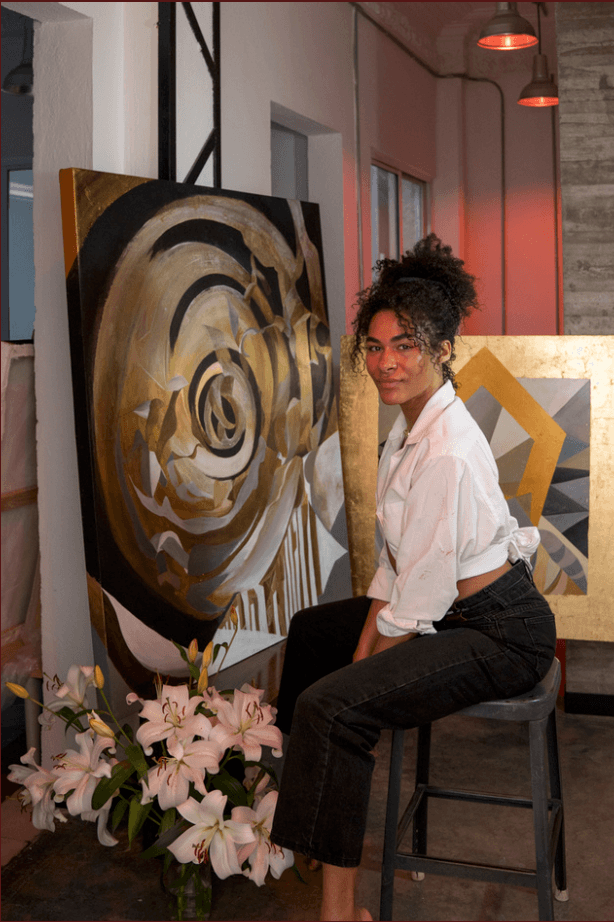
I make my paintings at a monumental scale to slow the body before the image. Hung together, they create the conversation that the news cycle could not sustain. They create a space where viewers can remain with ecological loss long enough to feel both its grief and its beauty.
A painting is finished only when it begins to behave like the natural systems that inspire it: when boundaries dissolve, relationships emerge, and everything begins to weave into everything else, from the microscopic to the planetary.
Gold appears throughout my work as a material reminder of alchemy.
The death of a star creates gold.
I do not use gold to beautify catastrophe, but to remind myself that transformation is woven into the fabric of existence. Life is never static. It adapts, evolves and continually reorganizes itself through relationship. My work asks what humanity might learn from that process.
Photography asks the same question through a different language.
If painting investigates systems, photography practices witnessing.
Every portrait begins with conversation. Before I photograph someone, I want to understand how they move through the world, what has shaped them, what they fear, what they love and how they have transformed difficulty into strength. The photograph is not simply a representation of a person, but the residue of a relationship.
Much of my photography centers queer people, women and people of color.
Not simply because they remain underrepresented.
Because their lives continually reveal forms of resilience, tenderness and self-determination that persist.
Resistance despite systems designed to suppress them.
Witnessing is an act of care.
Across painting, photography, film and installations, I return to the same question from different directions.
How do we remain alive to one another?
How do we remain alive to the Earth?
How do we continue to imagine when imagination itself feels threatened?
I do not believe art can stop a disaster or dismantle a system.
I believe it can make the invisible visible.
It can transform isolation into recognition.
It can create spaces where grief becomes connection rather than paralysis.
It can remind us that another way of relating—to ourselves, to one another, and to the living world—is still imaginable.
The question that guides my practice has no final answer.
How does a spirit stay alive under the weight of the world?
The practice of asking it again and again is itself an answer.
We witness.
We transmute.
We adapt.
And together, we continue.